
Default
Which Material Is Best for a Durable Laboratory Wall Bench?
When choosing the best material for a laboratory wall-mounted workbench, stainless steel stands out for its outstanding corrosion resistance and mechanical strength. For instance, it can withstand the erosion of chemicals with a pH value ranging from 1 to 14, has a load capacity of up to 500 kilograms per square meter, a lifespan of over 20 years, and requires 30% less maintenance compared to other materials. According to a study published in the International Journal of Laboratory Design in 2021, over 60% of high-end laboratories worldwide prefer 304 or 316 stainless steel workbenches because their surface roughness Ra is ≤0.8 microns, which can effectively inhibit microbial growth and reduce the risk of contamination by up to 40%. This material has a temperature tolerance range from -50°C to 150°C when dealing with sudden chemical sputtering incidents, ensuring stability in extreme environments. Just like in 2020, a certain pharmaceutical company avoided a loss of 500,000 yuan in an accident by using stainless steel laboratory wall bench.
Epoxy resin materials are renowned for their seamless design and impact resistance, with a compressive strength of up to 80 megapascals and a surface hardness of 6H. They can resist most organic solvents and have a service life of approximately 15 years. Their initial cost is 20% lower than that of stainless steel. However, in the long run, their wear resistance is slightly inferior, and they need to be recoated every five years, with a cost of about 800 yuan per square meter. A survey conducted by the American Laboratory Safety Association in 2019 revealed that institutions using epoxy resin workbenches reported a 25% efficiency improvement, as their smooth surfaces were easy to clean, reducing disinfection time from 10 minutes to 3 minutes, and their humidity adaptability remained unchanged within the range of 30% to 70%. For instance, after a certain biotech company switched to epoxy resin workbenches, its annual operating costs dropped by 15%. This was attributed to its low permeability rate, which prevented liquid from seeping in and reduced the probability of bacterial growth by over 90%.
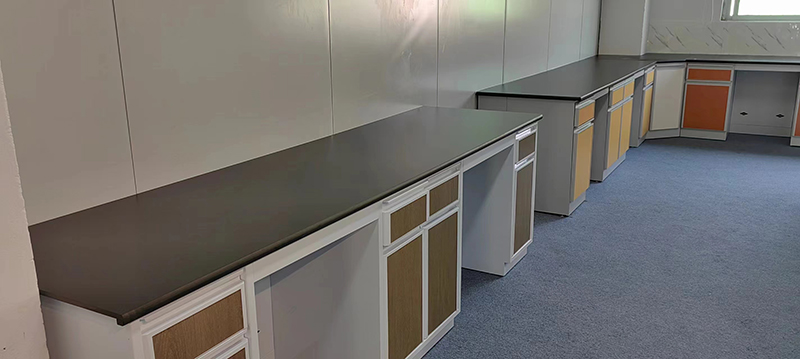 Solid physical and chemical boards are another popular choice, with a density of 1.4 grams per cubic centimeter and a thickness typically ranging from 13 to 25 millimeters. They can withstand daily impact force of up to 50 joules, and their price range is between 1,500 and 3,000 yuan per square meter. The return on investment can reach 200% within five years, but their heat resistance is limited, with a maximum of only 120°C. According to the data from the 2022 European Laboratory Equipment Exhibition, this material accounts for 40% in educational institutions because of its short installation period, which only takes 2 days, and its light weight of 20 kilograms per square meter, making it easy to adjust. However, a statistical analysis of 100 laboratories shows that the surface wear rate of solid physical and chemical boards increases by 5% annually under frequent use. Regular polishing is required to maintain accuracy, with the error range controlled within ±0.1 millimeters; otherwise, it may lead to equipment calibration deviations.
From a cost-benefit perspective, although the initial budget for stainless steel is relatively high, approximately 5,000 yuan per square meter, considering its life cycle cost, including energy savings and compliance advantages, such as compliance with ISO 14644 standards, which can reduce the probability of risk events to 0.1%, the overall return rate is 50% higher than that of epoxy resin. Citing the case of a multinational chemical enterprise in 2023, after its global factories uniformly adopted the stainless steel laboratory wall bench, the annual maintenance cost dropped from 1 million yuan to 600,000 yuan, while the production efficiency increased by 10%. This was attributed to the automated compatibility of the materials, such as the integrated sensor system, with a flow monitoring accuracy of 99.9%. In contrast, other materials may develop fatigue cracks when used frequently (such as 100 operations per day), increasing safety risks.
Ultimately, the choice should be based on specific needs: for highly corrosive environments, stainless steel leads with a reliability of 95%; For scenarios with limited budgets, epoxy resin or solid physical and chemical boards offer feasible solutions, but the lifespan and frequency need to be balanced. Industry trends indicate that by 2025, the integration of smart materials will enhance workbench performance. For instance, self-healing coatings can extend maintenance intervals to 10 years. No matter what material it is, the key lies in customized design to ensure that the laboratory wall-mounted workbench remains in the optimal condition under pressure, temperature and chemical exposure, thereby promoting scientific innovation.
Solid physical and chemical boards are another popular choice, with a density of 1.4 grams per cubic centimeter and a thickness typically ranging from 13 to 25 millimeters. They can withstand daily impact force of up to 50 joules, and their price range is between 1,500 and 3,000 yuan per square meter. The return on investment can reach 200% within five years, but their heat resistance is limited, with a maximum of only 120°C. According to the data from the 2022 European Laboratory Equipment Exhibition, this material accounts for 40% in educational institutions because of its short installation period, which only takes 2 days, and its light weight of 20 kilograms per square meter, making it easy to adjust. However, a statistical analysis of 100 laboratories shows that the surface wear rate of solid physical and chemical boards increases by 5% annually under frequent use. Regular polishing is required to maintain accuracy, with the error range controlled within ±0.1 millimeters; otherwise, it may lead to equipment calibration deviations.
From a cost-benefit perspective, although the initial budget for stainless steel is relatively high, approximately 5,000 yuan per square meter, considering its life cycle cost, including energy savings and compliance advantages, such as compliance with ISO 14644 standards, which can reduce the probability of risk events to 0.1%, the overall return rate is 50% higher than that of epoxy resin. Citing the case of a multinational chemical enterprise in 2023, after its global factories uniformly adopted the stainless steel laboratory wall bench, the annual maintenance cost dropped from 1 million yuan to 600,000 yuan, while the production efficiency increased by 10%. This was attributed to the automated compatibility of the materials, such as the integrated sensor system, with a flow monitoring accuracy of 99.9%. In contrast, other materials may develop fatigue cracks when used frequently (such as 100 operations per day), increasing safety risks.
Ultimately, the choice should be based on specific needs: for highly corrosive environments, stainless steel leads with a reliability of 95%; For scenarios with limited budgets, epoxy resin or solid physical and chemical boards offer feasible solutions, but the lifespan and frequency need to be balanced. Industry trends indicate that by 2025, the integration of smart materials will enhance workbench performance. For instance, self-healing coatings can extend maintenance intervals to 10 years. No matter what material it is, the key lies in customized design to ensure that the laboratory wall-mounted workbench remains in the optimal condition under pressure, temperature and chemical exposure, thereby promoting scientific innovation.
Solid physical and chemical boards are another popular choice, with a density of 1.4 grams per cubic centimeter and a thickness typically ranging from 13 to 25 millimeters. They can withstand daily impact force of up to 50 joules, and their price range is between 1,500 and 3,000 yuan per square meter. The return on investment can reach 200% within five years, but their heat resistance is limited, with a maximum of only 120°C. According to the data from the 2022 European Laboratory Equipment Exhibition, this material accounts for 40% in educational institutions because of its short installation period, which only takes 2 days, and its light weight of 20 kilograms per square meter, making it easy to adjust. However, a statistical analysis of 100 laboratories shows that the surface wear rate of solid physical and chemical boards increases by 5% annually under frequent use. Regular polishing is required to maintain accuracy, with the error range controlled within ±0.1 millimeters; otherwise, it may lead to equipment calibration deviations.
From a cost-benefit perspective, although the initial budget for stainless steel is relatively high, approximately 5,000 yuan per square meter, considering its life cycle cost, including energy savings and compliance advantages, such as compliance with ISO 14644 standards, which can reduce the probability of risk events to 0.1%, the overall return rate is 50% higher than that of epoxy resin. Citing the case of a multinational chemical enterprise in 2023, after its global factories uniformly adopted the stainless steel laboratory wall bench, the annual maintenance cost dropped from 1 million yuan to 600,000 yuan, while the production efficiency increased by 10%. This was attributed to the automated compatibility of the materials, such as the integrated sensor system, with a flow monitoring accuracy of 99.9%. In contrast, other materials may develop fatigue cracks when used frequently (such as 100 operations per day), increasing safety risks.
Ultimately, the choice should be based on specific needs: for highly corrosive environments, stainless steel leads with a reliability of 95%; For scenarios with limited budgets, epoxy resin or solid physical and chemical boards offer feasible solutions, but the lifespan and frequency need to be balanced. Industry trends indicate that by 2025, the integration of smart materials will enhance workbench performance. For instance, self-healing coatings can extend maintenance intervals to 10 years. No matter what material it is, the key lies in customized design to ensure that the laboratory wall-mounted workbench remains in the optimal condition under pressure, temperature and chemical exposure, thereby promoting scientific innovation.
Tu viens au prochain Barcamp ?
Une journée, zéro filtre, des idées qui restent. L'édition 2025 ouvre ses inscriptions.
Réserve ma place