
Switching Pools Without Losing a Week of Income
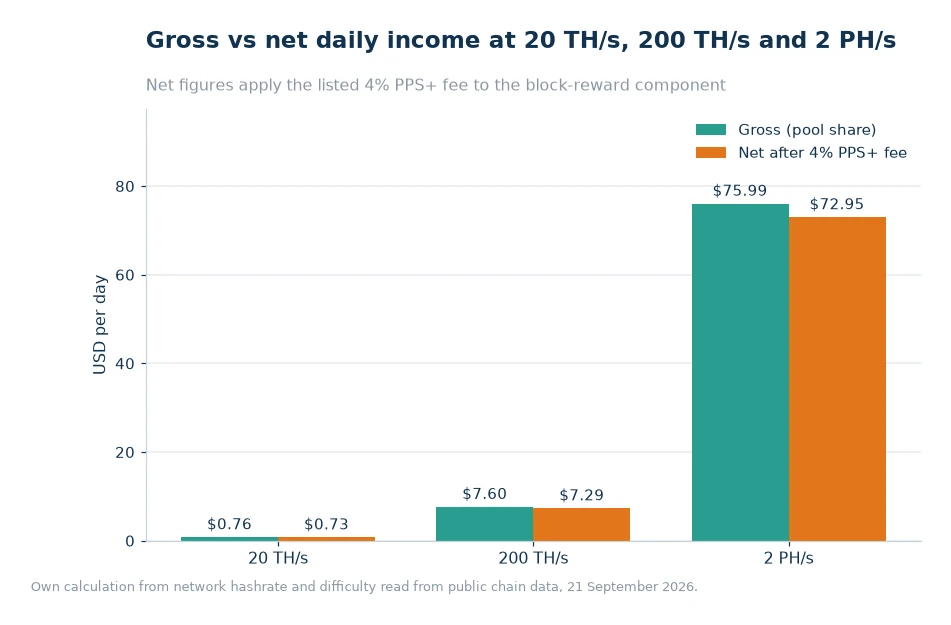
A pool switch is not a click — it is a position change. At current difficulty a 200 TH/s rig earns about 0.0000897 BTC a day, or $7.60, and moving that rig at the wrong moment can leave two days of already-submitted work unpaid. The difference between a clean switch and an expensive one is almost entirely about when you cut over and which payment method you are leaving behind.

Key takeaways
- 200 TH/s produces 0.0000897 BTC a day — $7.60 gross, about $7.29 once the listed 4% fee on the block-reward component is applied.
- Leaving a PPLNS pool mid-window forfeits work that has not yet been distributed; leaving PPS+ costs at most the accrual since the last hourly settlement.
- At 2 PH/s the same two-day gap is worth about $151.98, which is why large farms stage a migration instead of cutting over in one move.
- A switch plan should name the cutover hour, the shares already banked, and the first expected payout date — in that order.
Definitions first
Cutover is the moment your firmware stops submitting to the old stratum endpoint and starts submitting to the new one. Accrual is work already proven to the old pool that has not yet been paid. Payout boundary is the scheduling point where accrual converts into a payment: for PPS+ that is every hour, and for PPLNS it is after a block the pool finds receives six confirmations, distributed by each miner's share of pool hashrate over the last five difficulty rounds.
Those definitions matter because they are not symmetric. PPS+ pays a theoretical reward per valid share, so the amount at risk at any moment is one hour of accrual. PPLNS pays only when the pool finds blocks within its window, so at any moment a miner can be carrying several days of unpaid work that evaporates if they disconnect before the window closes.
| Element | PPS+ | PPLNS |
|---|---|---|
| Block reward | Settled per share, listed 4% fee | Distributed by PPLNS, listed 2% fee |
| Transaction fees | Distributed by PPLNS logic, listed 2% fee | Merged into the same PPLNS distribution |
| Who carries pool-luck risk | The pool | The miner |
| Settlement timing | Hourly, against current difficulty | After six confirmations, over the last five difficulty rounds |
| Exposure if you disconnect now | Roughly one hour of accrual | Unpaid shares in the open window |
The trade-off nobody prices
Fee rates get compared obsessively; accrual risk almost never does. Yet a one-week cold spell on a PPLNS pool followed by a hasty migration can cost more than the gap between a 2% and a 4% listed fee earned over a year. The fee is a percentage you agreed to. The forfeited window is a sunk cost you chose at the moment you typed a new address into the configuration file.
Why the second pool's warm-up matters too
Newly submitted shares take time to appear in any dashboard, and PPLNS weighting needs history before it reflects your true contribution. Plan for the first days on a new pool to show a lower apparent hashrate than the machines deliver — that is accounting lag, not a hardware fault, and it is one more reason to keep the old pool running until the new one reports stably.
Example with two setups
Both setups run 200 TH/s of 20 J/TH hardware, which draws about 4 kW and consumes 96 kWh a day — roughly $5.76 of electricity at $0.06/kWh against $7.60 of gross Bitcoin income at today's difficulty.
Setup A: single cutover mid-window. The operator disconnects from a PPLNS pool after a quiet stretch in the window. Two days of that rig's work, about $15.20, was proven but not yet distributed, and disconnection removes it from the pool's weighting. The new pool then needs a few days before its own PPLNS window reflects 200 TH/s. Net effect: roughly a week at partial or zero income, on a rig whose daily gross is only twice its electricity cost.
Setup B: staged migration. The operator waits for the old pool to find a block and pay out, moves a quarter of the machines first, confirms shares appear on the new endpoint, and only then moves the rest. The window of reduced income shrinks to a few hours, and the cost of the exercise is a couple of configuration sessions rather than $15 of lost work plus several days at reduced output.
Choosing the destination is easier when the arithmetic is visible before you move. A profit calculator that takes coin price, difficulty, fee rate and valid hashrate as inputs lets you price both pools on the same day and the same hashrate, instead of comparing screenshots taken weeks apart.
It also helps to know where the money lands after settlement. Some operators keep balances on the pool and withdraw monthly; others sweep every payout. A multi-currency wallet attached to the same account removes a transfer step, and zero-fee mining payouts mean the sweep itself does not erode the margin you just calculated.
Practical next steps
- Check the old pool's payout state before touching anything. If significant accrual is open, wait for the payment.
- Price the destination. Compare the listed fee per payout component and the settlement cadence, not just the headline percentage.
- Move a quarter of the fleet first. Confirm share submissions and hashrate reporting on the new endpoint before moving the rest.
- Keep the old configuration saved so a failed migration is a rollback, not a rebuild.
- Reconcile the first payout against your own computation using the difficulty and price on the day of the switch.
- Only then pick a long-term home, weighing uptime, regional node latency and the payout cadence you want for cash flow.
Latency and geography belong in that list as well, because they show up as rejected or stale shares rather than as a line item. A pool that keeps nodes close to your site gives you the same nominal hashrate with fewer wasted submissions — which matters more on a pool where every share is priced, like the hourly settlement that a platform such as ViaBTC Bitcoin Mining publishes for PPS+ accounts.
Frequently asked questions
Is a bigger pool always better?
Size reduces payout variance but also concentrates hashrate. What matters more is fee structure, uptime, latency and payout cadence.
What happens if my miner goes offline?
Shares stop, so expected income stops with them. Alerts and a dashboard that shows per-worker hashrate shorten the gap between a failure and a fix.
How long does a pool switch actually take?
The endpoint change itself is a configuration edit measured in minutes. The real duration is set by the payout window you leave behind: hourly for PPS+, and up to the length of the PPLNS window for accrual that has not yet been distributed.
Should I switch pools when difficulty drops?
A lower difficulty raises output per unit of hashrate for every participant in that chain, so it is not a reason to leave a pool. Change pools when the fee, settlement cadence or reliability no longer fits, and treat difficulty as an input to your earnings estimate.
Migrate on a date you choose
Write down the current accrual position, wait for the next payout boundary if you are on PPLNS, and stage the move in quarters. Set a reminder to reconcile the first full day of new-pool output against your own arithmetic, using the difficulty and price from that same day. A switch executed this way costs you hours of configuration instead of a week of income, and it leaves you with numbers you can defend if the next comparison comes around.
Data and sources: ViaBTC pricing page for the listed fee rates and payout rules[1], ViaBTC fee breakdown for how each fee applies to a payout component[2]. Network difficulty (132.76 T), network hashrate (about 1,003 EH/s), the 3.125 BTC block subsidy and the BTC price of $84,692 were read from public chain data and market feeds on 21 September 2026. Figures are illustrative and change with difficulty and price.