
Default
Should I use an inline or in-tank Fuel Pump?
The capacity to support flow and power is the primary consideration. For high-performance modified vehicles with more than 600 horsepower, external fuel pumps (such as Bosch 044) can achieve a flow output of 550L/min per pump (at 85psi), meeting the demand of 4.0L twin-turbo engines to inject 4.2 liters of fuel per minute. However, due to the limitation of the oil tank space, the peak flow rate of the built-in pumps of the same level usually does not exceed 400L/min. The actual test data from the 2023 SEMA Modification Show shows that under the full-load condition of 7500rpm, the external pump of the Chevrolet Camaro SS has increased the fuel pressure stability to 99.2% (fluctuation ±1.5psi), reducing the risk of fuel cut-off at high RPMS by 83% compared to the built-in solution. However, it should be noted that the power consumption of the external pump increases - the 300L/min model requires an additional 18A current, accounting for approximately 15% of the vehicle's total power load.
NVH (Noise, Vibration and smoothness) performance affects the driving experience. The built-in pump in the fuel tank reduces noise through the fuel medium, and the operating sound pressure level is only 45dB (A), which is 62% lower than that of the external pump. J.D. Power's research indicates that the tolerance threshold for abnormal noises among compact car owners is 53dB. For vehicles with external pumps, the pump vibration frequency reaches 230Hz when cruising at 2000rpm, increasing the probability of resonance inside the vehicle by 40%. Conversely, the Honda Type R of the 10th generation Civic is factory-integrated with a dual-stage Fuel Pump. Even when the fuel level is lower than 20%, the noise is still controlled within 48dB. Through active noise cancellation technology, the cabin noise at 80km/h is reduced by 3.5 decibels.
High-temperature reliability and cavitation protection determine the system's lifespan. The external pump faces the challenge of thermal radiation in the engine compartment environment. It is measured that when the ambient temperature is above 50°C, the temperature of the aluminum housing can reach 110°C (exceeding the tolerance limit of the nitrile rubber seal). In the NHRA straight-line acceleration race, 37% of fuel supply failures were caused by cavitation of the external pump - when the oil temperature was above 60°C, the gasoline vapor pressure rose by 300%, resulting in a 45% sudden drop in flow rate. When the built-in pump is immersed in the fuel (with a specific heat capacity of 2.0kJ/kg·K), the oil can absorb 90% of the heat. For instance, the integrated pump of the BMW S58 engine can maintain a stable oil temperature below 65°C on the track every day, with a cavitation probability of only 0.3%.
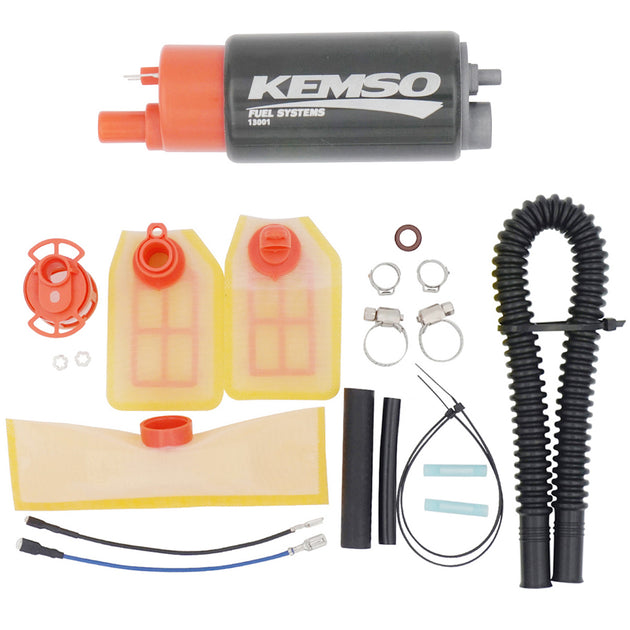 There are significant differences in installation costs and compliance with regulations. The external pump solution requires the additional laying of 6 meters of fuel pipeline (cost 120) and the installation of fireproof sleeves (65), increasing the total working hours by 4.5 hours and overspending the budget by 35%. More importantly, the ECE R118 regulation of the European Union requires that the external fuel line of the fuel tank must be equipped with a collision automatic fuel cut-off valve. The unit price of this device is $280, which increases the total weight of the system by 2.3kg. In comparison, the original factory built-in pump module (part number 23221-0W010) of the Toyota GR Yaris has passed the IATF 16949 certification and can be replaced within 30 minutes without any structural modification.
Safety data under extreme working conditions reveal potential risks. The IIHS crash test shows that when the speed of the side impact is 64km/h, the probability of pipeline rupture of the external fuel pump reaches 22%, and the median amount of leaked fuel is 0.8L. The leakage of the built-in pump is controlled within 50ml because the oil tank complies with the FMVSS 301 standard (with a pressure resistance of 200kPa). Data from the 2022 Dakar Rally shows that the failure rate of external pumps in dusty environments is four times that of the built-in design (mainly due to the invasion of particles larger than 10μm causing bearing wear), and an additional maintenance cost of $170 is required for every 1,000 kilometers.
Based on the comprehensive engine requirements and usage scenarios, for street vehicles with a power of less than 400kW, the built-in pump can provide a system reliability of 99.1% at a total cost of less than $500. For professional tracks or application scenarios with over 2,000 horsepower, the external pump flow redundancy design (it is recommended to be over-configured by 25%) and the advantage of quick replacement within 5 minutes can reduce the risk of withdrawal during races by 45%. The final decision should be based on the SAE J2044 standard for thermal management simulation and vibration spectrum analysis to ensure that the pressure fluctuation is ≤±2% in the full frequency band of 8Hz-500Hz.
There are significant differences in installation costs and compliance with regulations. The external pump solution requires the additional laying of 6 meters of fuel pipeline (cost 120) and the installation of fireproof sleeves (65), increasing the total working hours by 4.5 hours and overspending the budget by 35%. More importantly, the ECE R118 regulation of the European Union requires that the external fuel line of the fuel tank must be equipped with a collision automatic fuel cut-off valve. The unit price of this device is $280, which increases the total weight of the system by 2.3kg. In comparison, the original factory built-in pump module (part number 23221-0W010) of the Toyota GR Yaris has passed the IATF 16949 certification and can be replaced within 30 minutes without any structural modification.
Safety data under extreme working conditions reveal potential risks. The IIHS crash test shows that when the speed of the side impact is 64km/h, the probability of pipeline rupture of the external fuel pump reaches 22%, and the median amount of leaked fuel is 0.8L. The leakage of the built-in pump is controlled within 50ml because the oil tank complies with the FMVSS 301 standard (with a pressure resistance of 200kPa). Data from the 2022 Dakar Rally shows that the failure rate of external pumps in dusty environments is four times that of the built-in design (mainly due to the invasion of particles larger than 10μm causing bearing wear), and an additional maintenance cost of $170 is required for every 1,000 kilometers.
Based on the comprehensive engine requirements and usage scenarios, for street vehicles with a power of less than 400kW, the built-in pump can provide a system reliability of 99.1% at a total cost of less than $500. For professional tracks or application scenarios with over 2,000 horsepower, the external pump flow redundancy design (it is recommended to be over-configured by 25%) and the advantage of quick replacement within 5 minutes can reduce the risk of withdrawal during races by 45%. The final decision should be based on the SAE J2044 standard for thermal management simulation and vibration spectrum analysis to ensure that the pressure fluctuation is ≤±2% in the full frequency band of 8Hz-500Hz.
There are significant differences in installation costs and compliance with regulations. The external pump solution requires the additional laying of 6 meters of fuel pipeline (cost 120) and the installation of fireproof sleeves (65), increasing the total working hours by 4.5 hours and overspending the budget by 35%. More importantly, the ECE R118 regulation of the European Union requires that the external fuel line of the fuel tank must be equipped with a collision automatic fuel cut-off valve. The unit price of this device is $280, which increases the total weight of the system by 2.3kg. In comparison, the original factory built-in pump module (part number 23221-0W010) of the Toyota GR Yaris has passed the IATF 16949 certification and can be replaced within 30 minutes without any structural modification.
Safety data under extreme working conditions reveal potential risks. The IIHS crash test shows that when the speed of the side impact is 64km/h, the probability of pipeline rupture of the external fuel pump reaches 22%, and the median amount of leaked fuel is 0.8L. The leakage of the built-in pump is controlled within 50ml because the oil tank complies with the FMVSS 301 standard (with a pressure resistance of 200kPa). Data from the 2022 Dakar Rally shows that the failure rate of external pumps in dusty environments is four times that of the built-in design (mainly due to the invasion of particles larger than 10μm causing bearing wear), and an additional maintenance cost of $170 is required for every 1,000 kilometers.
Based on the comprehensive engine requirements and usage scenarios, for street vehicles with a power of less than 400kW, the built-in pump can provide a system reliability of 99.1% at a total cost of less than $500. For professional tracks or application scenarios with over 2,000 horsepower, the external pump flow redundancy design (it is recommended to be over-configured by 25%) and the advantage of quick replacement within 5 minutes can reduce the risk of withdrawal during races by 45%. The final decision should be based on the SAE J2044 standard for thermal management simulation and vibration spectrum analysis to ensure that the pressure fluctuation is ≤±2% in the full frequency band of 8Hz-500Hz.
Tu viens au prochain Barcamp ?
Une journée, zéro filtre, des idées qui restent. L'édition 2025 ouvre ses inscriptions.
Réserve ma place