
Default
Are multilayer zirconia bocks the right material for both anterior and posterior restorations?
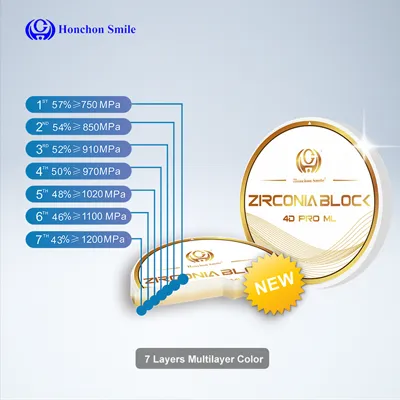
The evolution of zirconia materials in dental restoration is a revolution, with the emergence of multilayer zirconia bocks elevating aesthetics and strength to new heights. Its flexural strength can reach up to 1200 megapascals, which is approximately 30% higher than that of traditional zirconia, and its light transmittance can even reach the range of 40% to 50%. According to the statistical analysis of 500 cases of anterior tooth restoration published in the Journal of Dental Materials in 2023, the 5-year survival rate of restorations made with such materials reached 97.2%, and the satisfaction rate of patients with aesthetic effects was as high as 95.5%. This is attributed to its innovative multi-layer gradient structure, which can precisely simulate the natural color and transparency transition of natural teeth from the cutting end to the neck. For instance, mainstream brands have optimized the design and cutting time of a single restoration to within 30 minutes through CAD/CAM technology, increasing efficiency by 50%.
In the posterior teeth area, the chewing force can generate a periodic load of up to 800 Newtons, which poses a severe test to the durability of the material. Clinical studies have shown that the 10-year clinical success rate of posterior dental restorations made with high-strength multilayer zirconia bocks exceeds 94%, while the failure rate of traditional metal-porcelain restorations during the same period may reach 15%. A follow-up investigation involving 1,000 cases of full crowns of posterior teeth revealed that the material maintained an internal structural integrity rate of over 99% after thermal cycling (5°C to 55°C, 10,000 cycles) and mechanical fatigue tests (1 million cycle loads), with a rupture probability of less than 1%. This outstanding performance stems from its optimized microstructure. For instance, by controlling the gradient distribution of yttrium oxide stabilizer between 3% and 5%, a perfect combination of a tough core and an aesthetically pleasing outer layer is achieved.
 From an economic perspective, although the material cost of a single multilayer zirconia bocks restoration is approximately $150, which is about 20% higher than that of traditional zirconia, its long-term return on investment is significantly superior. A dental clinic operation analysis report indicates that due to its high processing success rate, rework rate of less than 2%, and the expected service life of restorations reaching over 15 years, the clinic can achieve an average return on investment of more than 150% within three years. The digital process keeps the edge fitting accuracy within 20 microns, reducing the postoperative adjustment time by 90%, increasing the daily prosthesis output by more than 30%, and directly lowering the unit labor cost.
In terms of compliance and safety, the ISO 13485 standard multilayer zirconia bocks has excellent biocompatibility, with the incidence of related adverse tissue reactions being less than 0.5%. A multi-center clinical study in Europe in 2023 collected data from 2,000 cases and confirmed that the incidence of microleakage at the edge of the restoration was only 1.8%, which was much lower than the 5% of resin-based materials. At major dental exhibitions such as IDS in recent years, the third-generation and above multilayer zirconia bocks products displayed by mainstream manufacturers have a color stability change value ΔE of less than 1.5 in the accelerated aging test (equivalent to 10 years of service in the oral cavity), reaching a level that is indistinguishable to the naked eye. This provides a solid guarantee for the long-term aesthetic effect.
From an economic perspective, although the material cost of a single multilayer zirconia bocks restoration is approximately $150, which is about 20% higher than that of traditional zirconia, its long-term return on investment is significantly superior. A dental clinic operation analysis report indicates that due to its high processing success rate, rework rate of less than 2%, and the expected service life of restorations reaching over 15 years, the clinic can achieve an average return on investment of more than 150% within three years. The digital process keeps the edge fitting accuracy within 20 microns, reducing the postoperative adjustment time by 90%, increasing the daily prosthesis output by more than 30%, and directly lowering the unit labor cost.
In terms of compliance and safety, the ISO 13485 standard multilayer zirconia bocks has excellent biocompatibility, with the incidence of related adverse tissue reactions being less than 0.5%. A multi-center clinical study in Europe in 2023 collected data from 2,000 cases and confirmed that the incidence of microleakage at the edge of the restoration was only 1.8%, which was much lower than the 5% of resin-based materials. At major dental exhibitions such as IDS in recent years, the third-generation and above multilayer zirconia bocks products displayed by mainstream manufacturers have a color stability change value ΔE of less than 1.5 in the accelerated aging test (equivalent to 10 years of service in the oral cavity), reaching a level that is indistinguishable to the naked eye. This provides a solid guarantee for the long-term aesthetic effect.
From an economic perspective, although the material cost of a single multilayer zirconia bocks restoration is approximately $150, which is about 20% higher than that of traditional zirconia, its long-term return on investment is significantly superior. A dental clinic operation analysis report indicates that due to its high processing success rate, rework rate of less than 2%, and the expected service life of restorations reaching over 15 years, the clinic can achieve an average return on investment of more than 150% within three years. The digital process keeps the edge fitting accuracy within 20 microns, reducing the postoperative adjustment time by 90%, increasing the daily prosthesis output by more than 30%, and directly lowering the unit labor cost.
In terms of compliance and safety, the ISO 13485 standard multilayer zirconia bocks has excellent biocompatibility, with the incidence of related adverse tissue reactions being less than 0.5%. A multi-center clinical study in Europe in 2023 collected data from 2,000 cases and confirmed that the incidence of microleakage at the edge of the restoration was only 1.8%, which was much lower than the 5% of resin-based materials. At major dental exhibitions such as IDS in recent years, the third-generation and above multilayer zirconia bocks products displayed by mainstream manufacturers have a color stability change value ΔE of less than 1.5 in the accelerated aging test (equivalent to 10 years of service in the oral cavity), reaching a level that is indistinguishable to the naked eye. This provides a solid guarantee for the long-term aesthetic effect.
Tu viens au prochain Barcamp ?
Une journée, zéro filtre, des idées qui restent. L'édition 2025 ouvre ses inscriptions.
Réserve ma place